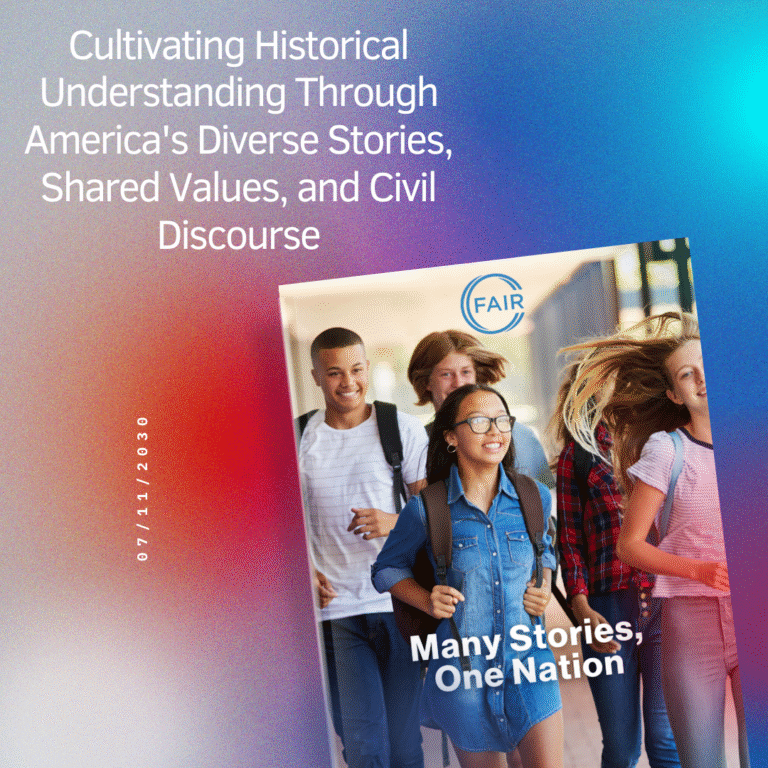

Looking for inclusive Ethnic Studies? Check out Our Many Stories, One Nation Curriculum

How do we balance individual and group identity with shared values in a diverse democracy?
How have marginalized groups experienced freedom, exclusion, resilience, and belonging?
How have these experiences challenged and expanded America’s founding ideals?
How do we balance individual and group identity with shared values in a diverse democracy?
How have marginalized groups experienced freedom, exclusion, resilience, and belonging?
How have these experiences challenged and expanded America’s founding ideals?

FAIR’s Many Stories, One Nation is a comprehensive high school Ethnic Studies course that examines American history and identity through the lived experiences of diverse and historically underrepresented groups within the unifying framework of America’s founding principles.

Students explore how Indigenous peoples, Black, Asian and Latino Americans, multiracial Americans, women, immigrants, and religious minorities have shaped—and been shaped by—the American experiment. By grounding these stories in historical evidence and pluralistic principles, FAIR’s curriculum explores how injustice and progress have shaped the American experience.

FAIR's Many Stories, One Nation Curriculum

FAIR’s Many Stories, One Nation is a comprehensive high school Ethnic Studies course that examines American history and identity through the lived experiences of diverse and historically underrepresented groups within the unifying framework of America’s founding principles.

Students explore how Indigenous peoples, Black, Asian and Latino Americans, multiracial Americans, women, immigrants, and religious minorities have shaped—and been shaped by—the American experiment. By grounding these stories in historical evidence and pluralistic principles, FAIR’s curriculum explores how injustice and progress have shaped the American experience.

Teaching Inclusive History That Brings Students Together

Students confront difficult histories—slavery, displacement, discrimination, exclusion—while also examining resilience, agency, reform movements, and democratic progress.

FAIR’s curriculum presents complex historical realities through primary sources and structured analysis, allowing students to reach their own conclusions. Our non-prescriptive approach empowers educators to bring inclusive history into their classrooms while maintaining academic rigor and community trust.

Student Experience

Students will engage in:

  • Primary Source Analysis: Students engage with primary sources, compare contrasting viewpoints on historical events, and analyze evolving interpretations of our founding documents.
  • Historical Investigation: Students research demographic changes, map patterns of migration, and examine socio-economic forces that influenced immigration.
  • Personal Connection: Students interview community members, research family histories and migration stories, and connect historical patterns to contemporary experiences.
  • Creative Application: Students create visual representations of adaptation models, design proposals to address diversity challenges, and develop guidelines for civic engagement.

Students practice civil discourse by:

  • Exploring Multiple Perspectives: Students examining diverse viewpoints on historical and contemporary issues, moving beyond binary thinking to understand nuanced positions.
  • Building Evidence-Based Arguments: Students learn to support positions with factual evidence, primary sources, and historical context while distinguishing between facts, interpretations, and opinions.
  • Practicing Respectful Engagement: Students demonstrate active listening, asking clarifying questions and responding to ideas rather than attacking individuals on emotionally charged topics.
  • Identifying Shared Values: Students discover areas of common ground despite significant disagreements, focusing on shared principles that can unite diverse viewpoints toward constructive solutions.

Curriculum Goals & Expected Impact

By the end of the course, students will be equipped to:

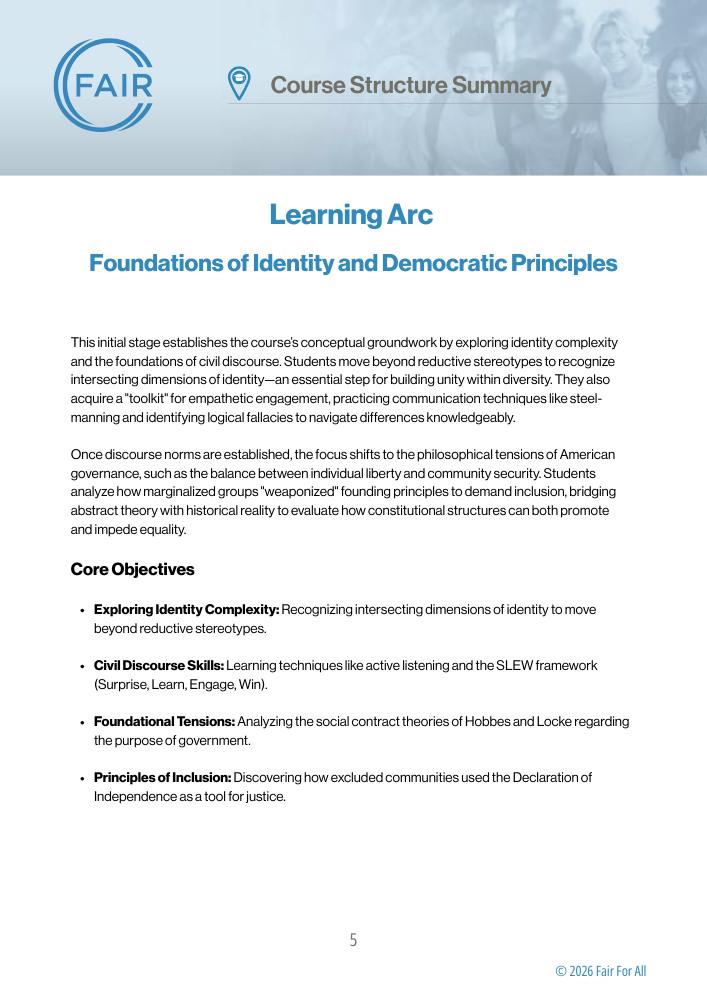
Learning Arc

This stage establishes the course’s conceptual groundwork by exploring identity complexity and the foundations of civil discourse. Students move beyond reductive stereotypes to recognize intersecting identities—an essential step for building unity. They also acquire a “toolkit” for empathetic engagement, practicing techniques like steel-manning and identifying logical fallacies to navigate differences.

Once discourse norms are set, the focus shifts to the philosophical tensions of American governance, such as the balance between individual liberty and community security. Students analyze how marginalized groups “weaponized” founding principles to demand inclusion, bridging abstract theory with historical reality to evaluate how constitutional structures impact equality.

Core Objectives

  • Identity Complexity: Moving beyond stereotypes to recognize multifaceted identities.

  • Civil Discourse: Mastering techniques like active listening and the SLEW framework (Surprise, Learn, Engage, Win).

  • Foundational Tensions: Analyzing Hobbes and Locke’s theories on the purpose of government.

  • Principles of Inclusion: Examining how the Declaration of Independence’s universal language became a tool for justice.

This stage applies foundational skills to a chronological study of American history, from the colonial era to the present. Students analyze how diverse groups—including the 47 million Black Americans and 65 million Hispanic Americans currently in the U.S.—navigated inequality through strategic agency. A central concept is the “Plinko Effect,” which explains how shared values can lead to different strategic conclusions depending on the historical context.

As the timeline reaches the modern era, students use philosophical frameworks—like colorblindness or race-conscious approaches—to interpret contemporary data and policy. They examine how historical exclusion influences current debates on race, gender, and immigration. By the end, students learn to see themselves as “bridge-builders,” recognizing how differing social movements often work in tandem to advance justice.

Core Objectives

  • Historical Agency: Viewing marginalized groups as strategic agents of change rather than passive victims.

  • Sovereignty and Resistance: Analyzing the political responses of Indigenous nations to settler colonialism.

  • The “Long Civil Rights Movement”: Tracking how legal victories for one group created constitutional tools for others.

  • Contemporary Policy Analysis: Applying “Competing Goods” frameworks to debates over affirmative action, reparations, and DACA.

The final stage, the Capstone Unit, tasks students with applying historical knowledge and discourse skills to 21st-century challenges. Students examine how digital platforms and social media algorithms can amplify division by exploiting psychological vulnerabilities. Positioned as “expert users,” they leverage their own experiences with technology to design solutions for more constructive and empathetic online engagement.

The course culminates in a project where students translate historical bridge-building strategies into modern digital contexts. Drawing inspiration from a “Bridge-Building Hall of Fame,” students develop a platform design, technology audit, or policy brief. This synthesis proves that civil discourse is a practical, essential tool for maintaining a functional, multiracial democracy in a high-tech society.

Core Objectives

  • Algorithmic Challenges: Understanding how social media creates echo chambers that hinder democratic dialogue.

  • Digital Discourse Practice: Using AI-powered platforms like SWAY to facilitate structured conversations on complex topics.

  • Historical Mentorship: Applying the strategies of a historical bridge-builder to guide modern digital solutions.

  • Authentic Application: Producing professional-grade projects that address real-world technological and social friction.

Teaching Approach & Resources

Many Stories, One Nation encourages students to engage with primary sources, multiple perspectives, and thoughtful discussion. Each unit includes:

  • Essential Questions that frame student inquiry
  • Primary Sources that bring historical voices to life
  • Civil Discourse Exercises that develop skills for respectful dialogue Learning Activities that encourage active engagement
  • Assessment Options that measure deeper understanding

Professional development workshops are available to help teachers implement this curriculum effectively, focusing on facilitating productive discussions around complex topics.

Our Team

Dr. Adam Seagrave

Associate Professor of Civic and Economic Thought and Leadership at Arizona State University and a co- founder and co-director (with Dr. Stephanie Shonekan) of the Race and the American Story Project

Dr. Ashley Rogers Berner

Deputy Director of the Johns Hopkins Institute for Education Policy and an Associate Professor in the Johns Hopkins School of Education. Served as Codirector of Moral Foundations of Education at the Institute for Advanced Studies in Culture

Dr. David Ferrero

An independent education consultant and FAIR education fellow with teaching experience at the Universities of Michigan, Washington, and Drexel, Dr. Ferrero brings a unique perspective on educational transformation to the FAIR curriculum.

Jonathan Burack

A Harvard graduate with an M.A.T. degree, Jonathan created the acclaimed MindSparks history materials, focusing on primary source interpretation and historical thinking skills. His development of programs like History Unfolding and Debating the Documents has shaped how countless students engage with historical materials.

Dr. Kobi Nelson

With a Ph.D. in Education and Human Development and two decades of educational experience, Dr. Nelson brings classroom-tested expertise to the Capstone portion of FAIR’s curriculum.

Lisa Gilbert

A seasoned public health professional with a Master’s degree from UCLA’s School of Public Health, Lisa Gilbert brings a unique perspective on youth development to FAIR’s team.